
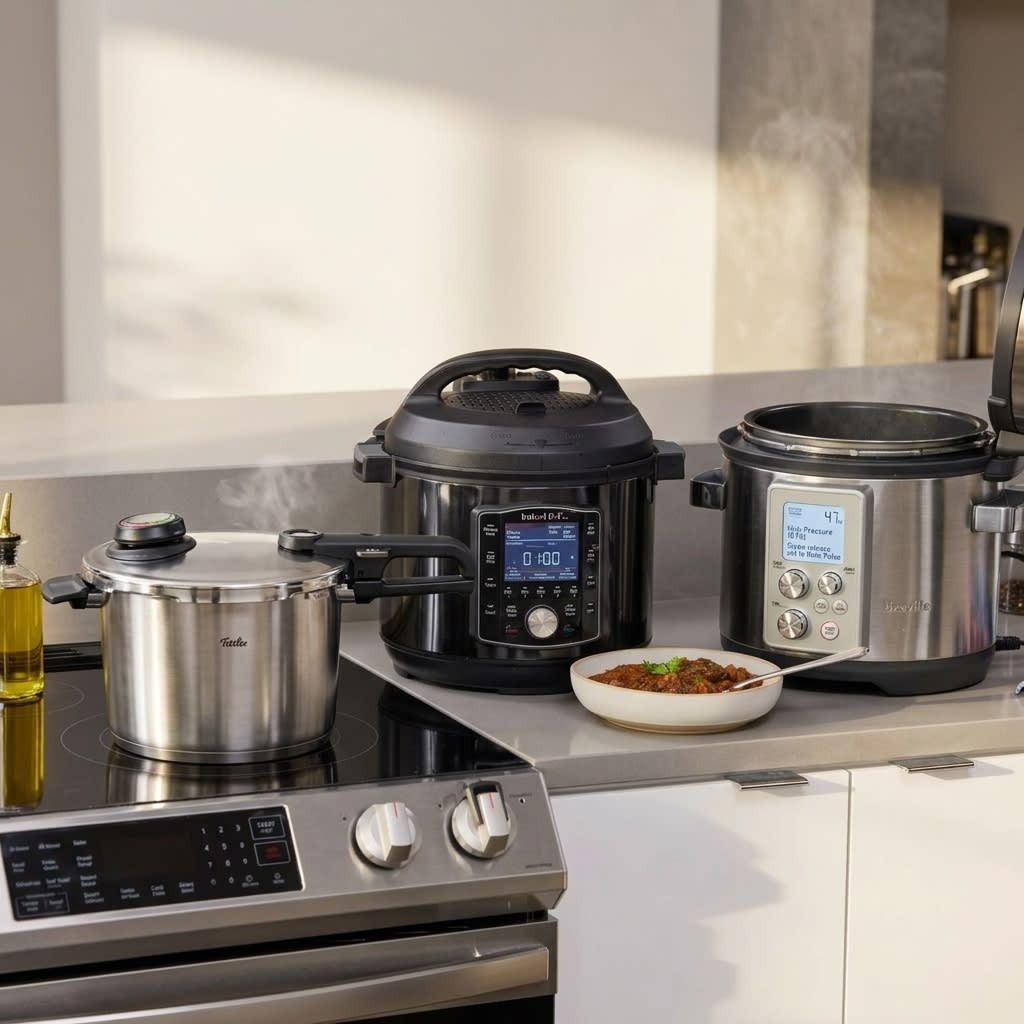
Our Picks
Why Electric Pressure Cookers are Not True BIFL
The short answer: Buy the Instant Pot Duo 7-in-1 — not because it's the toughest machine here, but because it's the only one you can keep alive for pennies. Its parts ecosystem is so deep that a failed $6 sealing ring or $4 float valve never becomes a reason to throw the cooker away. Every ranking below applies that same test: not how it cooks on day one, but who's still selling you parts in year five.
- Want a true lifetime tool? No electric cooker qualifies. Buy a mechanical stovetop pressure cooker (Kuhn Rikon, Fissler) and skip this category entirely.
- Skip anything app-dependent — when the company kills the servers, your cooker loses the features you paid a premium for.
- Skip non-stick inner pots. Bare stainless or nothing; a coating is a built-in expiration date.
Here is the hard truth about electric pressure cookers: they are not buy-it-for-life appliances. No matter how premium the brand, any machine with a circuit board, a digital screen, and microprocessors will eventually fail when subjected to repeated high-heat and steam cycles. Thermal stress degrades the internal capacitors and sensors over time, giving even the best electric models a typical functional lifespan of 2 to 9 years.
If you choose to use an electric model, your real metric for longevity is repairability and spare parts availability. When a small valve cracks or a gasket leaks, a machine is only as good as the spare parts you can actually buy from first- or third-party sellers. This guide ranks the most popular electric pressure cookers on the market based on construction quality, real-world owner longevity, and the availability of replacement parts.
Key Longevity Metrics: What Actually Matters
Spare Parts Access is the Real Longevity Metric
Silicon gaskets, float valves, and sealing rings are consumable items that naturally stretch, degrade, and absorb odors over time. You will need to replace them every 12 to 18 months. Before buying any cooker, verify that the manufacturer (or reliable third-party brands) actively stocks replacement parts. If a company goes out of business or locks parts behind a customer-service wall, the appliance becomes e-waste the moment a single silicone ring fails.
Operating Pressure Defines Cooking Speed
Most electric pressure cookers max out at 10 to 12 PSI, meaning they run cooler and cook slower than traditional stovetop models that reach 15 PSI.
Bare Stainless Steel Pots Beat Non-Stick Coatings
Always choose a cooker with a bare stainless steel inner pot. Ceramic or PTFE non-stick coatings are highly fragile. They scratch easily from metal spoons or bone-in meats, and the coating naturally degrades after a few years of washing, forcing you to replace the entire pot. Bare 18/8 stainless steel is practically indestructible.
Mechanical Simplicity Reduces Failure Points
Complex automated steam-release motors, color-changing LCD screens, and multiple built-in sensors add convenience but create more electronic components that can short-circuit or degrade under high steam exposure. The simpler the interface, the longer the base unit will last.
The Category's Recall Rap Sheet
Electric pressure cookers are one of the most-recalled appliance categories in America, and the failures cluster in the same place: lids and seals. In February 2026, the CPSC told owners of certain Gourmia cookers to stop using them and throw them away over serious burn hazards. In late 2025, Aldi recalled about 46,000 Ambiano cookers after eight people were burned when lids opened before the pressure was gone. Before that: roughly 914,000 Crock-Pot Express multi-cookers in 2020 (lids detaching under pressure, 119 burn reports), about 930,000 Insignia cookers in 2023 (incorrect fill-line markings), and around 860,000 Sensio-built cookers the same year.
As we write this (June 2026), none of the six cookers in this guide are under an active CPSC recall — though one has recall history in the family tree, which we cover in its review. Two habits keep you out of these statistics: never force a lid open or closed (if it resists, there is pressure behind it), and if you buy any cooker secondhand, run the model number through cpsc.gov before the first cook.
Instant Pot Duo 7-in-1 is the best electric compromise
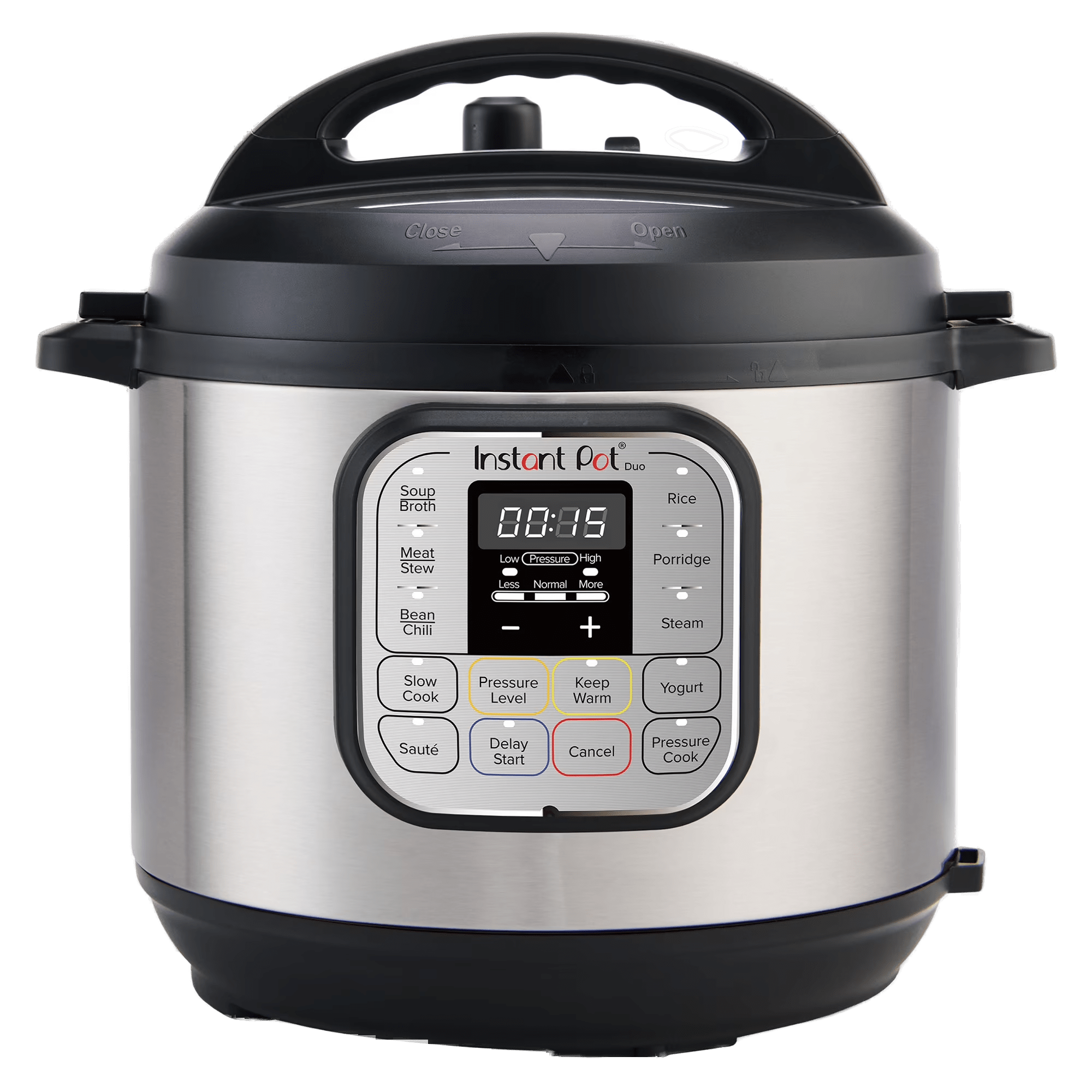
Instant Pot Duo 7-in-1 (6-Qt)
The classic workhorse of the electric pressure cooker world. While its electronic base has a finite lifespan, its bare stainless steel pot and ubiquitous, cheap replacement parts make it the most sensible long-term compromise.
Pros
- Durable food-grade 18/8 stainless steel pot with tri-ply bottom
- Universal spare parts ecosystem with valves and gaskets sold everywhere
- Tactile buttons and simple digital display reduce motherboard failure points
- Highly cost-effective with frequent retail discounts under $90
Cons
- Operating pressure is capped at 11.6 PSI (slower than 15 PSI stovetop models)
- Slow cook function heats only from the bottom rather than wrapping around
- Silicone sealing ring absorbs strong food odors over time
The Instant Pot Duo is the most popular electric pressure cooker in the world, and it represents the most sensible compromise between modern convenience and durability. While the electronic base will eventually fail after 4 to 7 years of regular use, the Duo offers a massive advantage: a universal parts ecosystem.
Because Instant Pot has a massive install base, replacement parts are everywhere. You can easily buy sealing rings, float valves, steam handles, power cords, and bare stainless steel inner pots from the manufacturer or dozens of third-party sellers on Amazon at very low costs. This easy access to parts means a small component failure will never force you to throw the machine away.
The inner pot is made from bare 18/8 stainless steel with a tri-ply bottom, making it durable and dishwasher safe. The interface uses simple physical buttons and a basic LED display rather than a fragile touchscreen, reducing electronic failure points.
Common failures are well-documented and often fixable. A blown thermal fuse (designed to cut power if the unit overheats) can be replaced by users comfortable with basic electronics. Moisture-driven sensor desync (C6H or C6L error codes) sometimes resolves after letting the base dry for 72 hours.
Instant Pot Pro offers premium features with parts bottlenecks
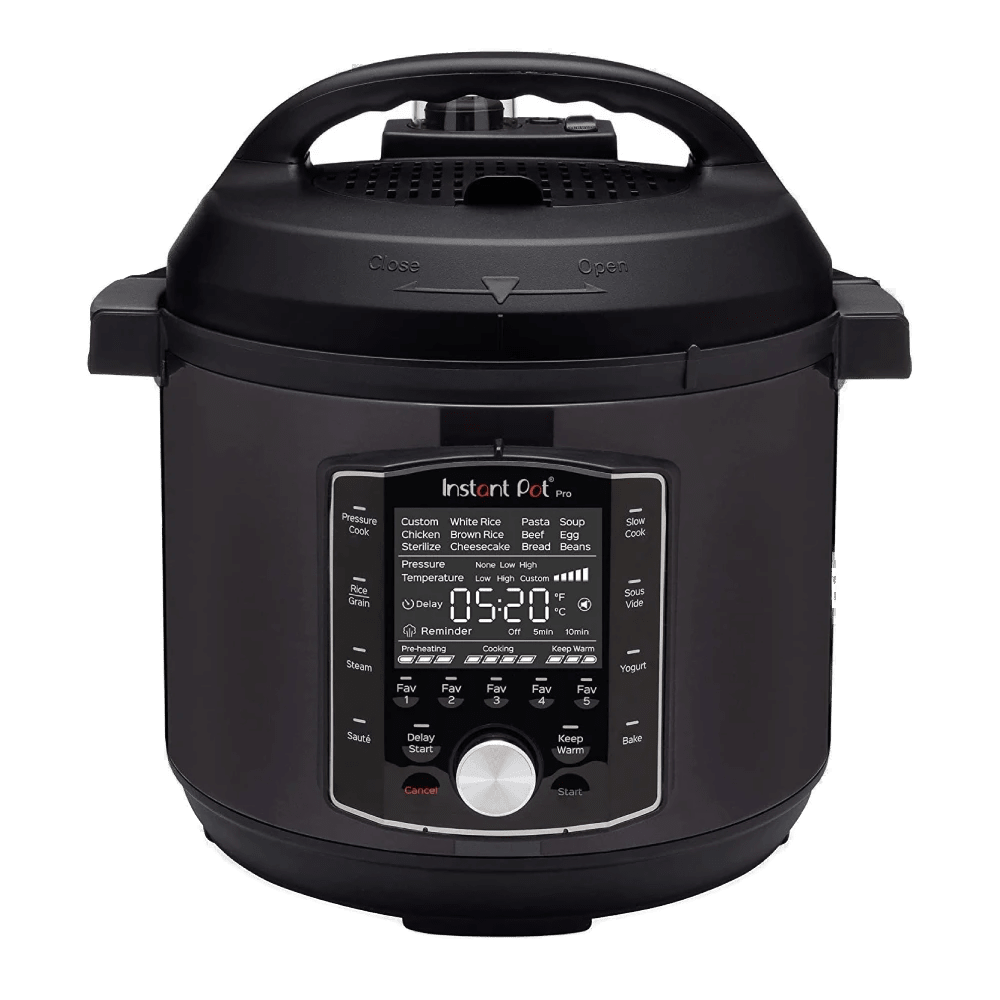
Instant Pot Pro (6-Qt)
A premium upgrade with fantastic usability features like pot handles and quiet venting, but held back by proprietary parts bottlenecks for the lid's valve cap.
Pros
- 1200W heating element reduces pre-heating times by 20%
- Stove-top and oven safe flat-bottomed inner pot with handles
- Upgraded Whisper Quiet steam release switch covered by a diffusing cap
Cons
- Proprietary metal valve cap is small, easily lost, and can be difficult to source replacements
- Jog-dial menu requires more clicks and the screen is hard to read from wide angles
The Instant Pot Pro was introduced as a high-end upgrade to the Duo, featuring a 1200W heating element that speeds up pre-heating times, a quieter Whisper Quiet steam release switch, and a flat-bottomed inner pot with silicone-wrapped handles that prevent it from spinning. While these are excellent upgrades for daily use, the Pro suffers from severe long-term maintenance bottlenecks.
The primary durability issue is the redesigned steam release valve. The Pro uses a heavy metal cap that sits over the steam pipe, covered by a plastic diffusing shield. Owners frequently report losing this small internal metal valve cap during routine washing. Because the cap is a proprietary design, the cooker cannot seal or build pressure without it.
Worse, Instant Brands does not consistently stock replacement valve caps for the Pro — and the company's 2023 Chapter 11 (it emerged under private-equity owner Centre Lane Partners) has not improved the parts bench. When users lose this piece, they often find it out of stock on the official website, forcing them to search for overpriced third-party parts on eBay or buy an entire new lid.
The Pro also suffers from a unique sensor failure. The internal pressure switch can lose calibration, refusing to tell the logic board that the unit is pressurized. As a result, the heating element continues to blast heat, causing the safety valve to vent steam continuously. Given these parts shortages and sensor issues, the Pro is a poor choice for long-term reliability.
Breville Fast Slow Pro delivers precision cooking with high failure rates
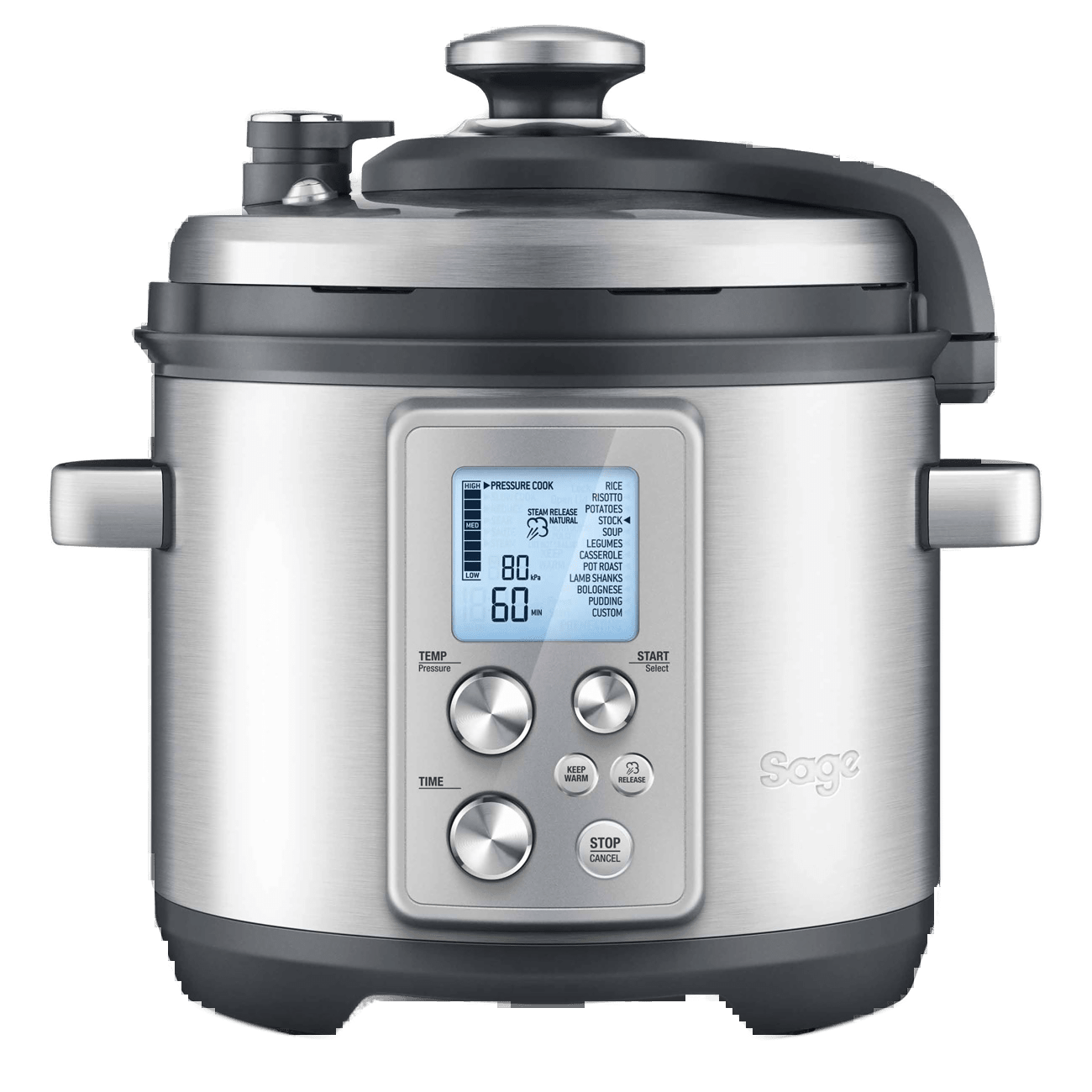
Breville Fast Slow Pro (6-Qt)
The ultimate choice for gourmet cooks who want precise pressure calibration and automated steam release, though you must accept the vulnerability of a non-stick pot.
Pros
- Precise manual pressure control from 1.5 to 12.0 PSI
- Hands-free automated steam release safety system
- Dual sensors (top and bottom) for high thermal accuracy
Cons
- Expensive premium price and larger counter footprint with hinged lid design
- Fragile ceramic non-stick coating scratches easily and has no stainless steel alternative
- Complex electronics and motorized valves introduce more failure points than simple manual cookers
The Breville Fast Slow Pro is a luxury multi-cooker designed for culinary enthusiasts. It offers unmatched control, allowing users to manually adjust operating pressure from 1.5 to 12.0 PSI across eight levels, and features an interactive LCD screen that changes color during cooking. However, its complex engineering translates to a fragile durability profile.
Breville also knows this category's risks firsthand. Its predecessor model, the Fast Slow Cooker BPR600XL, was recalled in December 2015 — about 35,600 units — after gaskets installed upside down let lids release hot food, causing second-degree burns. The Pro's hands-free automated steam release and lid-lock logic are, in part, the engineering answer to that history. Credit for fixing it — but the recall is worth knowing about if you're shopping used.
The most critical BIFL issue is the inner pot. Unlike the stainless steel pots used by Instant Pot, the Breville uses a ceramic non-stick coating. Ceramic coatings scratch easily from bone-in meats or metal utensils, and they naturally lose their non-stick properties over time. Once the coating degrades or chips, you must purchase a replacement pot directly from Breville.
The Fast Slow Pro also houses highly complex electronic systems, including dual thermal sensors (at the top and bottom) and a motorized hands-free steam release valve. This complexity introduces many electronic failure points. Owners frequently report logic board failures, sensor desynchronization, and steam-release motor burnouts within 1 to 2 years of purchase.
While Breville runs an excellent OEM parts store selling replacement pots, gaskets, and lids, the high failure rate of the base unit's complex electronics makes it a risky investment for long-term kitchen use.
Cosori Pressure Cooker offers thoughtful safety features but has a non-stick pot
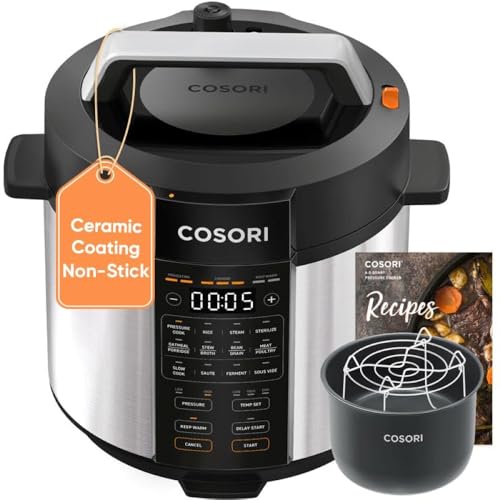
Cosori Pressure Cooker 6-Qt (CMC-CO601-SUS)
An excellent safety-first entry for beginners who want to avoid accidental steam burns, backed by a great warranty, but limited by a non-stick pot.
Pros
- Dedicated steam release button placed safely away from the steam valve
- Angled 30-degree steam vent directs hot vapor back and away from cabinets
- Double-layer anti-scalding lid and a solid 2-year warranty
Cons
- Ceramic non-stick aluminum pot is vulnerable to scratches compared to bare stainless steel
- Touch control screen and digital panels add electronic vulnerability
- Proprietary replacement gaskets are harder to find than for Instant Pot
The Cosori 9-in-1 Pressure Cooker (Model CMC-CO601-SUS) operates at 1100W power and features a 6-quart capacity. It stands out in the marketplace for its thoughtful physical safety features. The manual steam release button is located on the lid handle completely separate from the steam release valve, preventing accidental steam burns. The steam vent is angled backward at 30 degrees to direct steam away from cabinets, and the lid has a double-layer anti-scalding design to keep the exterior cooler to the touch.
However, from a BIFL durability perspective, it shares a common limitation with other high-tech countertop units. The inner pot is made of aluminum with a ceramic non-stick coating. Unlike the bare stainless steel pots of the Instant Pot models, this ceramic coating will eventually degrade, scratch, or wear off under repeated washing, necessitating a proprietary replacement pot. The digital touch-screen display panel also presents another electronic component that can fail over time.
Cosori provides a solid two-year warranty, which is twice as long as the standard coverage of many competitors. Still, finding third-party replacement gaskets and seals can be challenging compared to the ubiquitous Instant Pot ecosystem.
Chef iQ Smart Cooker offers high tech convenience but poor longevity

CHEF iQ Smart Pressure Cooker (6-Qt)
The top choice for tech-lovers who want a guided cooking experience with an integrated scale, though it carries long-term software dependency risk.
Pros
- Integrated kitchen scale weighs ingredients directly in the pot
- Automatic steam release valve with multiple venting modes
- Vibrant full-color LCD screen and smartphone app integration
Cons
- Fragile ceramic non-stick aluminum pot is vulnerable to scratches
- High software and server dependency for core smart features
- Complex internal sensors and motherboard make DIY repairs nearly impossible
The CHEF iQ Smart Cooker is the most technologically advanced option on the market, featuring a built-in kitchen scale that weighs ingredients directly in the pot, automatic steam release control, and a full-color LCD screen that syncs with an app to guide users through recipes. While these features make it highly approachable for beginners, the reliance on high-tech software and thin materials makes it a poor BIFL choice.
The primary durability concern is the inner pot. CHEF iQ uses a thin aluminum pot coated in a ceramic non-stick material. Aluminum is prone to warping under extreme heat cycles, and the ceramic coating scratches easily, limiting its lifespan. Unlike Instant Pot, there is no bare stainless steel alternative available from the manufacturer.
The cooker is also heavily dependent on its digital systems. Owners frequently report connectivity drops, failed firmware updates that lock the screen, and sensor errors. The automatic steam release relies on a motorized valve inside the lid, which represents another mechanical component that can fail over time. When the electronics or sensors degrade (such as the common "low pressure switch" error), the unit is not user-repairable.
And app-reliant appliances carry an obsolescence risk all their own. If the manufacturer decides to discontinue software updates or shut down their servers, the cooker loses the smart features that justify its premium price tag.
Zavor LUX LCD is a lesson in orphan risk

Zavor LUX LCD Multi-Cooker (6-Qt)
A highly capable chef's workhorse with exceptional heat distribution and pressure, but carries single-point-of-failure orphan risk since Zavor America ceased operations.
Pros
- Professional-grade hardware with a thick, bare stainless steel inner pot
- Belt-style heating element wraps around the perimeter for exceptionally even heat distribution
- Reaches up to 13.0 PSI, higher than most electric countertop models
Cons
- Orphaned brand (Zavor America closed), leaving the unit with no official manufacturer warranty or direct support
- Replacement parts for proprietary electronics or control boards are unavailable
- Owner reports of recurring E4 sensor errors that render the unit inoperable
Here is the reality of the boutique market: Zavor America ceased operations, meaning there is no longer any official manufacturer warranty or direct customer support. This is the second time this hardware line has been orphaned—originally, it was sold as the Fagor LUX, which died overnight when Fagor America collapsed in 2018. Former employees regrouped to launch Zavor, but the brand has now met a similar end.
Credit where it is due: the physical hardware remains impressive. The brushed stainless inner pot is thick and durable, and the belt-style heating element wraps around the perimeter of the base rather than just sitting at the bottom, delivering remarkably even heat distribution and browning. It is also one of the few electric models capable of reaching a higher 13.0 PSI.
However, the lack of corporate backing is a major long-term risk. While basic consumable parts like gaskets and sealing rings can still be sourced via third-party providers like ADCO Service, proprietary electronic components, LCD boards, or internal sensors cannot be replaced. Furthermore, long-term owners have reported recurring E4 sensor errors that render the cooker completely inoperable. Without a company to stand behind it, buying a Zavor means accepting single-point-of-failure orphan risk.
The $15 Day-One Parts Kit (Do This Before First Use)
Most "dead" electric pressure cookers that get thrown out didn't die — they failed on a $6 ring or a $4 valve, and nobody had the part on hand. So here's the habit that separates a four-year cooker from a nine-year one: order the consumables the same day you order the cooker.
For an Instant Pot Duo, roughly $15 buys the full kit: two spare sealing rings, a float valve with silicone cap, and a condensation collector. Buy two rings, not one, and dedicate them — one for savory, one for desserts and dairy. Silicone absorbs odors permanently, and a cheesecake steamed inside a ring that's cooked a hundred curries will taste like it.
Then run the water test twice a year: one cup of water, high pressure, two minutes. If the cooker reaches pressure and holds it, the seal system is healthy. If it hisses from the rim or never pressurizes, swap the ring, re-seat the float valve, and test again before you blame the electronics. Between uses, store the lid upside-down on the pot so the ring breathes — a compressed, smelly ring fails years early.
The Reddit Consensus on Electric Longevity
Enthusiast communities on r/BuyItForLife and r/pressurecooking emphasize a clear consensus: do not expect lifetime service from any electric multi-cooker.
Users frequently note that older, basic electric models with simple mechanical dial switches lasted longer than modern units with complex digital screens. When shopping for electric convenience, the community advice is to stick to the most basic, high-volume models (like the Instant Pot Duo) because parts are cheap and easy to find.
If true multi-generational durability is your primary goal, the community advice is to avoid electric models entirely and purchase a premium stovetop pressure cooker (like Kuhn Rikon or Fissler). Stovetop models rely entirely on mechanical valves and replaceable gaskets, allowing them to last decades with minimal maintenance.
The Bottom Line
Electric pressure cookers are five-to-nine-year appliances. Buy them knowing that, and buy the one you can keep on life support cheapest: the Instant Pot Duo, whose parts ecosystem turns every small failure into a ten-minute fix. The Pro is a superior chef-friendly cooker but carries small proprietary valve cap bottleneck risks. The Breville is for culinary enthusiasts who prioritize temperature precision and automatic hands-free venting. The Cosori has the safest physical layout of the budget set, while the CHEF iQ is the ultimate guided smart scale cooker. The **Zavor** is a hardware masterpiece orphaned by its company's closure.
The deeper pattern runs through the whole kitchen: simple, bare-metal tools outlive clever coated ones. It's the same lesson behind our electric kettles guide, where a $100 Cuisinart routinely outlives a $200 smart kettle. It's why we tell you to build around bare stainless cookware, and it's why the stainless inner-pot rule in this guide is non-negotiable. If most of what you'd use a multicooker for is rice, skip the pressure-cooker aisle entirely — a dedicated rice cooker is the simpler, longer-lived tool. And for the categories where buy-it-for-life is actually achievable, browse the rest of our kitchen & cooking reviews — the mechanical stuff is where the heirlooms live.
Product Comparison at a Glance
| Product | Our Score | Brand | Best For | Operating Pressure | Parts Availability | Inner Pot | Action |
|---|---|---|---|---|---|---|---|
#1Instant Pot Duo 7-in-1 (6-Qt) | 9.0 | Instant Pot | Budget-Friendly Reliability | 11.6 PSI | Excellent (Ubiquitous first- and third-party parts) | 18/8 Stainless Steel (tri-ply) | |
#2Instant Pot Pro (6-Qt) | 7.2 | Instant Pot | Searing and Quiet Venting | 11.6 PSI | Poor (Proprietary cap bottlenecks) | Stainless Steel (Flat-bottom & Handles) | |
#3Breville Fast Slow Pro (6-Qt) | 6.5 | Breville | Precision Cooking and Texture Control | Variable (1.5–12.0 PSI) | Moderate (Expensive direct replacement parts) | Ceramic Non-Stick | |
#4Cosori Pressure Cooker 6-Qt (CMC-CO601-SUS) | 6.0 | Cosori | Safety-First Beginners | 11.6 PSI | Moderate (Great warranty, proprietary gaskets) | Ceramic Non-Stick Aluminum | |
#5CHEF iQ Smart Pressure Cooker (6-Qt) | 5.5 | CHEF iQ | Guided Tech and Built-in Scale | 11.5 PSI | Low (Proprietary software, complex sensors) | Ceramic Non-Stick Aluminum | |
#6Zavor LUX LCD Multi-Cooker (6-Qt) | 4.0 | Zavor | High Pressure Workhorse | 13.0 PSI | Low (Orphaned brand, ADCO basic support only) | Brushed Stainless Steel |