
Our Picks
The Best Slim EDC Power Banks at a Glance
Short on time? Here is the quick version. For pure pocketability, the Clutch Pro is the thinnest thing here that still saves your phone. If you want one bank that can also nurse a laptop back to life, the INIU SnapGo Air 10K pushes a real 45W. Want to ditch cables completely? The Baseus PicoGo snaps to the back of an iPhone with a kickstand built in. And if you just want a cheap brick that refuses to die, the Anker 313 PowerCore is the one.
Every pick below sits at 10,000mAh or less, weighs under half a pound, and disappears into a front pocket or a small bag. The comparison above shows the trade-offs side by side; the reasoning behind each pick is further down.
What to Look For in an Everyday-Carry Power Bank
The best EDC power bank is the one you have on you when your phone hits 3%. A 20,000mAh monster that lives in a drawer because it is too heavy does nothing for you. So the whole game is balancing four things.
Thickness and weight
This is the one spec that decides whether you actually carry it. Anything under 0.6 inches thick and under half a pound rides comfortably in a front pocket. The wallet-thin 5,000mAh models like the Clutch Pro vanish entirely; the chunkier 10,000mAh banks are happier in a jacket pocket or a bag.
Capacity: 5,000 vs 10,000mAh
For everyday carry, 5,000mAh to 10,000mAh is the sweet spot. A 5,000mAh bank gives a modern phone roughly one full top-up; 10,000mAh gets you closer to two, or one charge with enough left over for earbuds. Go bigger than that and you are hauling weight you almost never use.
How it connects: cable, MagSafe, or Qi2
A power bank with a full battery and no cable is a paperweight. Built-in cables, like the ones on the UGREEN Uno and Clutch Pro, fix that for good. Magnetic banks that use MagSafe or the newer Qi2 standard skip cables and stick straight to the back of the phone. We go deep on those in our Qi2 and MagSafe guide.
Output, in plain watts
For topping off a phone, 15W to 20W is plenty. If an ultrabook ever tags along, you want 30W or, better, 45W. Once you need to charge a full laptop at speed, you have left slim-EDC territory and want a proper laptop power bank instead.
mAh vs. Wh: Why a 10,000mAh Bank Charges Your Phone About 1.5 Times
Here is the math nobody on the box wants you to do. A 10,000mAh power bank does not put 10,000mAh into your phone. That rating is measured at the cell's voltage, around 3.7V. To charge your phone, the bank has to step that up to 5V, or 9V for fast charging, and voltage conversion is never free. After those losses plus a little heat, you typically see 60 to 70 percent of the rated number actually reach your device.
Want the real figure in a unit that does not lie? Convert to watt-hours. Multiply the mAh by 3.7 and divide by 1,000. A 10,000mAh bank is about 37Wh. A typical phone battery holds roughly 12 to 19Wh, so 37Wh of stored energy realistically means about 1.5 to 2 phone charges. The box that promised three was counting raw cell capacity and hoping you would not check. The 5,000mAh pocket models land around 18.5Wh, or one honest charge. That Wh number is also how you find out whether a bank is allowed on a plane, which brings us to the part most travelers get wrong.
Can You Bring a Power Bank on a Plane in 2026?
Yes, and slim EDC banks are the easiest of all to fly with. Every model on this list is 37Wh or less, which sails under the limits. The rules did tighten in 2026, though, so here is what actually changed.
The capacity limit
Power banks up to 100Wh fly with no approval needed, and that is a high ceiling: 100Wh is roughly 27,000mAh, so any 5,000 or 10,000mAh EDC bank is nowhere close. Between 100Wh and 160Wh you need the airline's sign-off, and anything above 160Wh is banned from passenger flights.
Carry-on only, and out of the overhead bin
Lithium banks have always been carry-on only, never checked luggage. The new part for 2026: after an October 2025 overhead-bin fire on Air China flight CA139, United and a growing list of carriers now require power banks to stay on your person, in a seat pocket, or in your under-seat bag, not in the overhead bin.
You may not be allowed to charge it in flight
This is the rule travelers miss. Under IATA's 2026 dangerous-goods update, charging a power bank from an in-seat USB port is banned, and 20-plus airlines (Emirates, Qantas, Japan Airlines and the Lufthansa group among them) now ban using power banks during the flight at all. A separate ICAO rule rolling out across member states in March 2026 caps you at two power banks per passenger and bars recharging them in the air. The takeaway: charge your bank fully before you board.
Clutch Pro - The Minimalist's Choice

Clutch Pro
It is designed to save your phone when it hits 8% during a commute, and for that specific task, it is unmatched.
Pros
- Incredibly thin at 0.2 inches
- Integrated charging cable
- Fits perfectly in a wallet or cardholder
Cons
- Only 5,000mAh capacity
- Gets warm during sustained use
- Not suitable for laptops or tablets
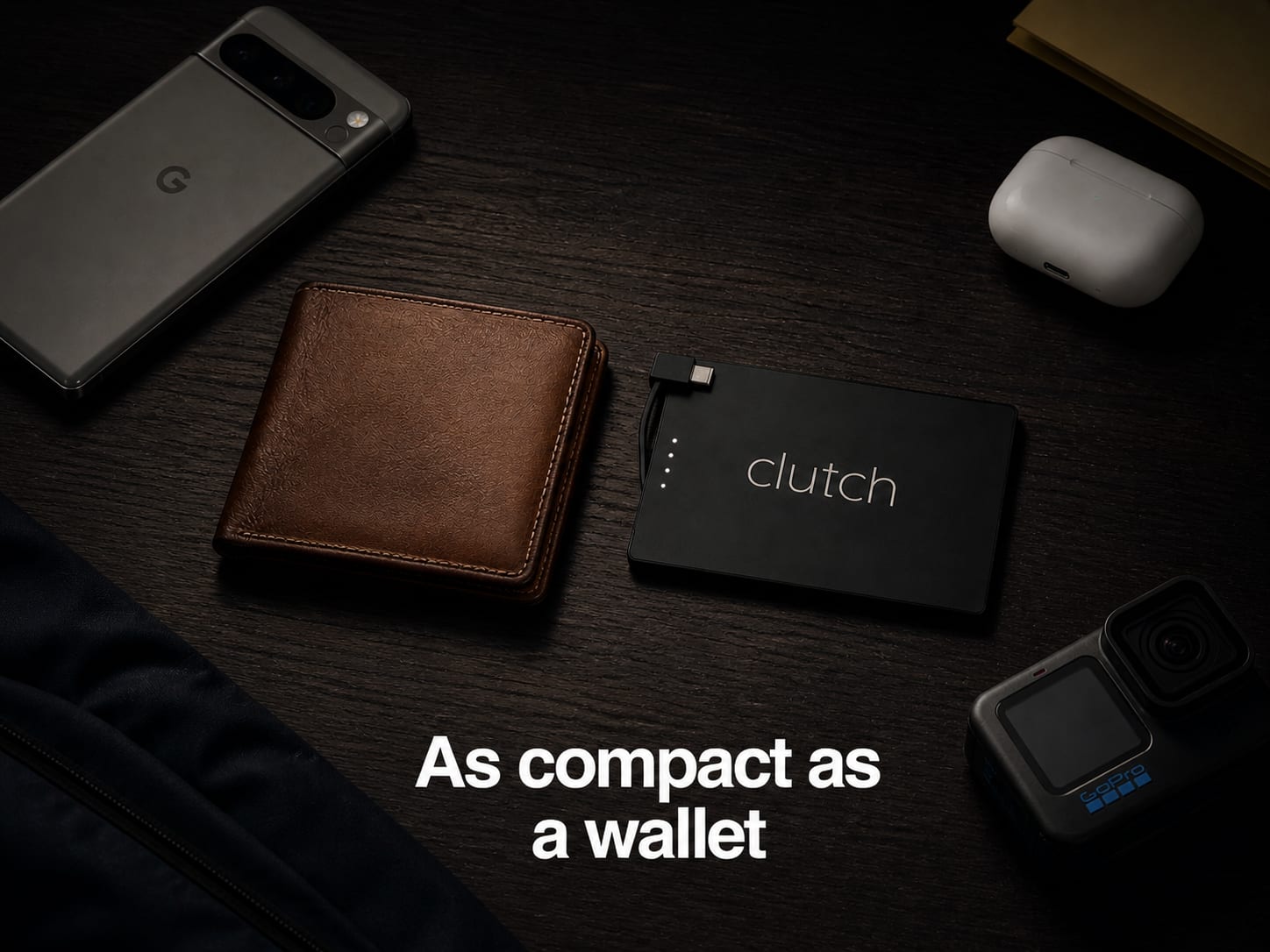
The Clutch Pro is built around a single idea: you cannot forget it, because it lives in your wallet. At 0.2 inches thick it has the footprint of about three stacked credit cards, and the cable is built in, so a full battery is never stranded behind a missing cord.
The trade-off is being honest about what 5,000mAh buys you, which is one emergency charge for a big-screen phone, full stop. There is no room inside something this thin for heat to escape, so the metal body gets noticeably warm during a sustained 20W pull. It will not revive a laptop or keep a tablet alive on a long flight. But as the thing that rescues your phone at 8% on the train home, nothing else here is this invisible.
INIU SnapGo Air 10K - Best for Power Users

INIU SnapGo Air 10K
If you carry a laptop alongside your phone every day, this is the most capable option that still fits comfortably in a coat pocket.
Pros
- Massive 45W output in a slim form factor
- Qi2.2 standard for 25W wireless charging
- GoCord doubles as a carrying strap
Cons
- Thermal throttling during sustained high output
- Slightly heavier than basic 5K banks
Most banks this slim top out at 20W. The SnapGo Air pushes a genuine 45W over USB-C PD, enough to give a thin-and-light laptop a real top-up in a pinch, and at 196g it is the smallest bank here we would trust near a laptop at all. It also runs the newer Qi2.2 standard for 25W magnetic wireless, a clear step up from the 15W you get on older MagSafe hardware.
Physics still applies. Push 45W through a chassis this light for long enough and the thermal management dials it back to protect the cells, so sustained full-speed sessions taper off. The bundled GoCord doubles as a wrist strap and means you always have a fast cable on hand. For anyone hauling a laptop and a phone every day, this is the most capable option that still fits a coat pocket.
UGREEN Uno 10K - The Commuter's Best Friend

UGREEN Uno 10K
It is the perfect grab-and-go solution for students and daily commuters who want to eliminate cable anxiety.
Pros
- Integrated 1.6-foot braided USB-C cable
- 30W two-way fast charging
- Animated TFT display for status
Cons
- Integrated cable cannot be replaced if broken
- Robot face animations aren't for everyone
Forgot your cable again? With the UGREEN Uno that is impossible: it has a 1.6-foot braided USB-C cable built into the body, long enough to actually use while the bank sits in your bag. Charging runs both ways at 30W, so it refills its own cells about as fast as it tops up your phone.
The TFT screen shows charge status as little animated robot faces, which you will either love or quietly ignore. Either way the hardware underneath is solid, with layered safety protection across the outputs. The one real risk is structural: if the integrated cable ever frays, you cannot swap it. The braided jacket holds up to daily abuse well enough that most owners never hit that wall. For students and commuters who just want to grab and go, it is the easy call.
Baseus PicoGo - Best Compact with Kickstand

Baseus PicoGo
An exceptionally compact MagSafe option with Qi2 speeds and a convenient built-in stand, perfect for everyday carry.
Pros
- Ultra-compact at 0.5" thick
- Built-in aluminum kickstand
- 15W Qi2 wireless & 20W USB-C wired charging
Cons
- Heavier than non-stand models (4.8 oz)
- 5,000mAh capacity provides ~1.5 charges
Smaller than a credit card at 0.5 inches thick, the Baseus PicoGo (model PPPG-0520S) still finds room for a trick the others skip: a built-in aluminum kickstand. Snap it to the back of your phone with the 11-magnet MagSafe array and you have a propped-up screen for videos on a tray table.
The 5,000mAh cell is good for roughly 1.5 iPhone charges, delivered at 15W over Qi2 wireless or 20W on the USB-C cable. The kickstand adds a little weight, 4.8 ounces, which is the only thing keeping it from feeling weightless. If you want magnetic charging without committing to a thicker bank, it makes an excellent everyday companion.
Anker 313 PowerCore - The Reliable Backup

Anker 313 PowerCore
It is a dead-simple, highly reliable brick. It can bounce around the bottom of a backpack for months and still function perfectly.
Pros
- Practically indestructible build quality
- Accurate rated capacity (37Wh)
- Dedicated trickle-charge mode for earbuds
Cons
- Extremely slow 5.5-hour recharge time
- Max 15W output via USB-A only
The Anker 313 is the oldest design here, and it shows. It charges over USB-A at a maximum of 15W, the USB-C port is input-only, and a full refill takes a sluggish 5.5 hours. If you care about speed, keep scrolling.
It earns its spot by being nearly indestructible. It can rattle around the bottom of a backpack for months, take drops, and still work the moment you need it. Its rated 37Wh holds up in real use too, which is more than a lot of no-name banks can say after quietly missing their numbers. There is also a low-current mode that safely trickle-charges earbuds without cooking the battery. One note for the nervous: Anker's large 2025 recall covered the older PowerCore 10000 (model A1263) and several MagGo banks, not the 313 (model A1262). It is a dead-simple brick, and that is the entire appeal.
Which Slim Power Bank Should You Buy?
It comes down to what you carry and how much you care about cables. Want something that genuinely disappears into a pocket or a wallet? The Clutch Pro. Carrying a laptop and want one bank that covers both? The INIU SnapGo Air 10K. Hate cables and live in the Apple ecosystem? The Baseus PicoGo and its magnets. And if you just want a cheap, tanklike backup that survives your bag for years, the Anker 313 PowerCore. Still not sure which fits your routine? Try the matchmaker below, or browse the rest of our tech and electronics guides.
Product Comparison at a Glance
| Product | Our Score | Brand | Capacity | Thickness | Max Output | Best For | Action |
|---|---|---|---|---|---|---|---|
#1Clutch Pro | 9.0 | Clutch | 5,000mAh | 0.2 inches | 20W | True Minimalism | |
#2INIU SnapGo Air 10K | 9.5 | INIU | 10,000mAh | 0.6 inches | 45W | Laptop + Phone | |
#3UGREEN Uno 10K | 9.3 | UGREEN | 10,000mAh | 0.7 inches | 30W | Cable-Free Carry | |
#4Baseus PicoGo | 8.8 | Baseus | 5,000mAh | 0.5 inches | 15W (Wireless) | Compact Kickstand | |
#5Anker 313 PowerCore | 8.5 | Anker | 10,000mAh | 0.6 inches | 15W | Extreme Durability |